Foundations, Frameworks and Feasibility: NSW Charts Twenty Years of Growth as Major Projects Move Ahead
This week's reporting was led by consents and the blueprints behind them, with three major projects moving ahead alongside a new twenty year plan for Sydney.
The Minns Labor Government announced that it had settled the Sydney Plan, a 20 year framework built around a population it expects to reach 6.6 million by 2046, calling for a minimum of 800,000 additional homes and 950,000 additional jobs, with employment targets set for each local government area for the first time and every council obliged to hold 30 years of feasible housing capacity under its Local Environmental Plan [1]. On approvals, the Government confirmed State Significant Development consent for the $2 billion Bankstown Hospital together with the engagement of Multiplex as Early Contractor Involvement building partner, ahead of a main works start in 2027 [4]. Architecture AU reported federal approval of the Sydney Airport Master Plan 2045 and the appointment of the same contractor to the opening package of the domestic terminal expansion [6].
Procurement, standards and the pipeline carried the second strand. At an Australian Constructors Association forum of more than 450 industry figures in Sydney, the NSW Treasurer and the Association pressed for reform of procurement, risk allocation and delivery practice [7]; a 46 page draft from Forest and Wood Products Australia would hand structural engineers a national design method for cross laminated timber, open for comment until 29 September [5]; and the Commonwealth invited a shortlist of rolling stock and systems proponents to bid on Phase 1A of the Sydney to Newcastle high speed rail corridor, inside a $230 million development phase running to early 2028 [9]. On the private pipeline, documents for a $1 billion, 81 megawatt data centre at St Leonards were lodged with the NSW Government [3]. On business structure, an industry submission to Treasury argued that a proposed federal trust tax reaches builders through their licences rather than their tax rates [2].
The Sydney Plan Lands, and Councils Take On a Thirty Year Capacity Test
The Minns Labor Government announced that it had settled the Sydney Plan, describing it as a 20 year framework under which housing, employment and infrastructure are planned together as the city moves from 5.3 million residents to 6.6 million by 2046 [1]. The release puts Sydney's requirement at a minimum of 800,000 additional homes and 950,000 additional jobs across those two decades, with employment targets apportioned to each local government area for the first time [1]. It records that the draft went on exhibition in late 2025 and drew over 2,000 submissions before the plan was settled, and that the document steers extra housing to the eastern half of the city while pushing economic growth west on the strength of Western Sydney International Airport and the Aerotropolis [1].
Two commitments in the release bear directly on the supply pipeline. The Government undertook to settle refreshed five year targets with councils once the National Housing Accord concludes in 2029, and confirmed that each council will have to keep at least three decades of feasible housing capacity available under its Local Environmental Plan [1]. Minister for Planning and Public Spaces Paul Scully said the plan "locks in a requirement for an ongoing pipeline of feasible housing supply, so we do not find ourselves back in the position we are in today" [1].
Two further instruments were released alongside it. The Government described the State Land Use Plan as the first of its kind in NSW, creating three tiers in which the state document steers regional plans and those in turn steer local strategic planning [1]. The Statewide Policy for Industrial Lands sorts industrial land into tiers of state, regional and local importance, which the release presents as giving industry, councils and communities greater certainty about what is protected [1]. It puts the annual value of Western Sydney's manufacturing, construction, warehousing, transport and logistics sectors at more than $83 billion, and characterises the three documents together as the largest reshaping of strategic planning the state has seen in decades, intended to inform future investment and rezoning decisions [1].
Consents Granted at Bankstown and Sydney Airport, Contractors Appointed Early
The NSW Government announced that the new $2 billion Bankstown Hospital had reached a major milestone, with its State Significant Development application approved and a builder engaged to help settle planning and design [4]. Multiplex has been appointed as the Early Contractor Involvement building partner and will sit alongside the project team, the designers and hospital staff and clinicians to complete the design before main works begin [4]. Demolition and site remediation are under way and will run through 2026, ahead of a main works start the Government expects in 2027 [4]. The release describes the project as the largest single capital commitment the state has made to a public hospital, and as part of an $11.9 billion programme covering 32 new or upgraded hospitals [4].
On scope, the Government confirmed that the hospital will sit in the Bankstown central business district close to the future Bankstown Metro station, and will comprise a 14 storey hospital building, a multi storey car park and a separate emergency drop off area [4]. Architecture AU reported that Architectus and Billard Leece Partnership designed the approved scheme, that Aspect Studios prepared the landscape design, and that Yerrabingin led the connecting with Country work [8]. Planning Minister Paul Scully said the approval was "a major boost for Bankstown, giving local communities better access to modern health facilities closer to home" [8].
The same delivery model appeared at the airport. Architecture AU reported federal approval of the Sydney Airport Master Plan 2045, covering an enlarged T1 international terminal and a substantial rebuild of the domestic terminals at T2 and T3, against a forecast that the airport will handle close to 73 million passengers a year by 2045, up from 42 million today [6]. The masthead noted that Grimshaw and Mott MacDonald were appointed earlier this year to lead design of the combined domestic terminal precinct, and that Multiplex has now been engaged for Early Contractor Involvement on the opening works package, starting this month with construction due to begin in 2027 [6]. Sydney Airport group executive for planning and delivery Paul Willis said early collaboration "will help us test how the project can be built and staged safely and efficiently, while minimising impacts on passengers, airlines and airport operations" [6].
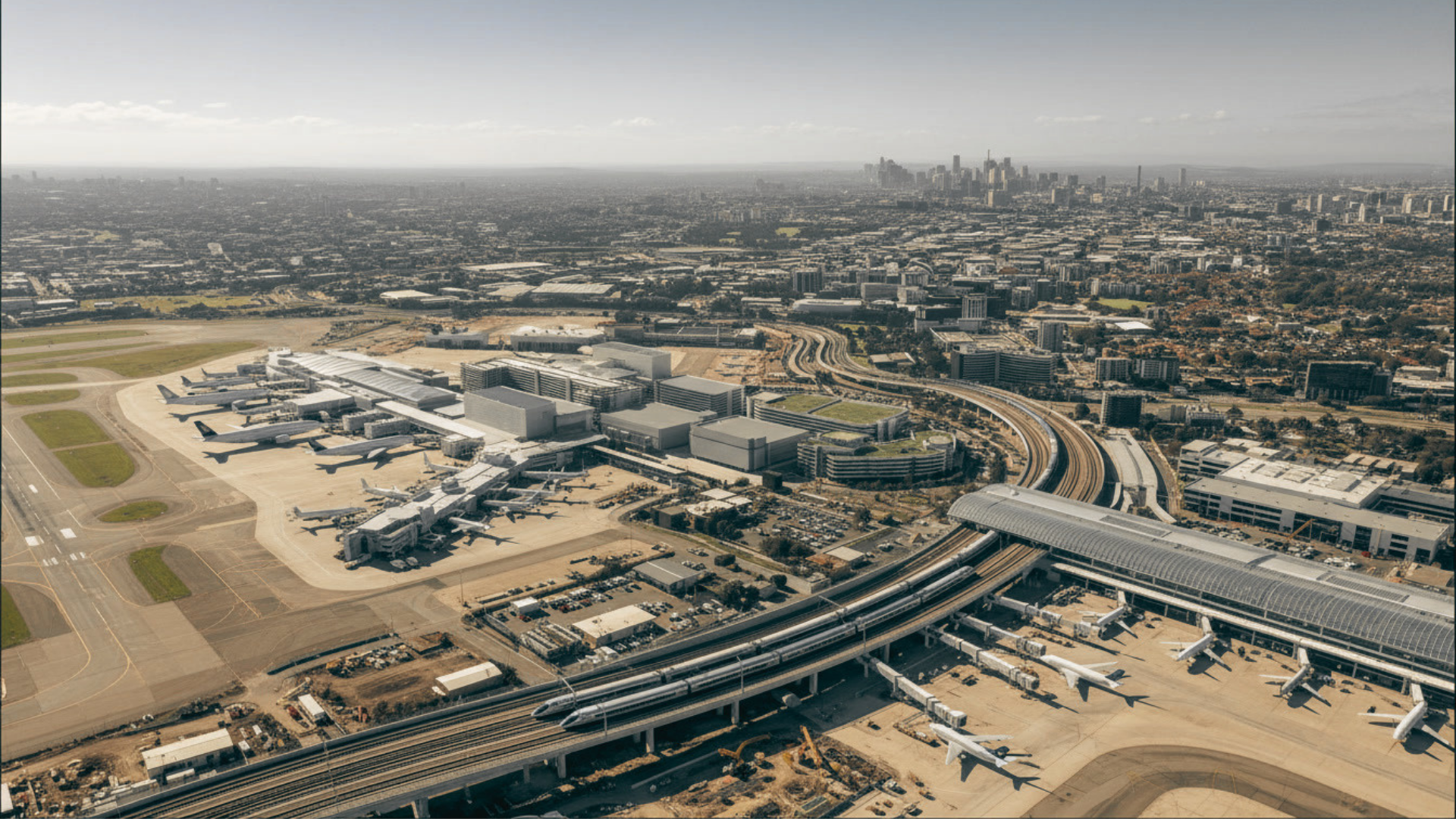
High Speed Rail Systems Go to Market as Data Centre Load Reaches St Leonards
PS News reported that the Commonwealth has asked a shortlist of rolling stock, systems and tunnelling specialists to bid on Phase 1A of the Sydney to Newcastle high speed rail corridor [9]. The publication put the development phase at $230 million, running to early 2028 and intended to leave the line construction ready for a start in 2029, with Phase 1A carrying a projected cost of roughly $55 billion once stations and trains are counted, and services capable of beginning as early as 2038 [9]. The trains are to be built to run at up to 320 kilometres per hour [9].
This newsletter reported the shortlist of construction consortia for Area Package 1 in its edition of 20 August 2026. PS News has now set out the parallel systems shortlist, naming three proponents: Hitachi Rail STS Australia; the ARC Joint Venture, which pairs Mott MacDonald Australia with Siemens Mobility and Siemens Mobility GmbH; and the Alstom and UGL Joint Venture, which brings together Alstom Transport Australia with UGL Engineering [9]. Each has been directed to start from trains and systems with a proven operating record overseas and adapt them to Australian conditions, and the High Speed Rail Authority is using the Early Contractor Involvement process to lock down cost, scope, design and approvals so the Australian Government can reach an investment decision once the development phase ends [9]. Authority chief executive Tim Parker said that bringing the systems partners in now "means we can design the railway around the customer experience from the start" [9].
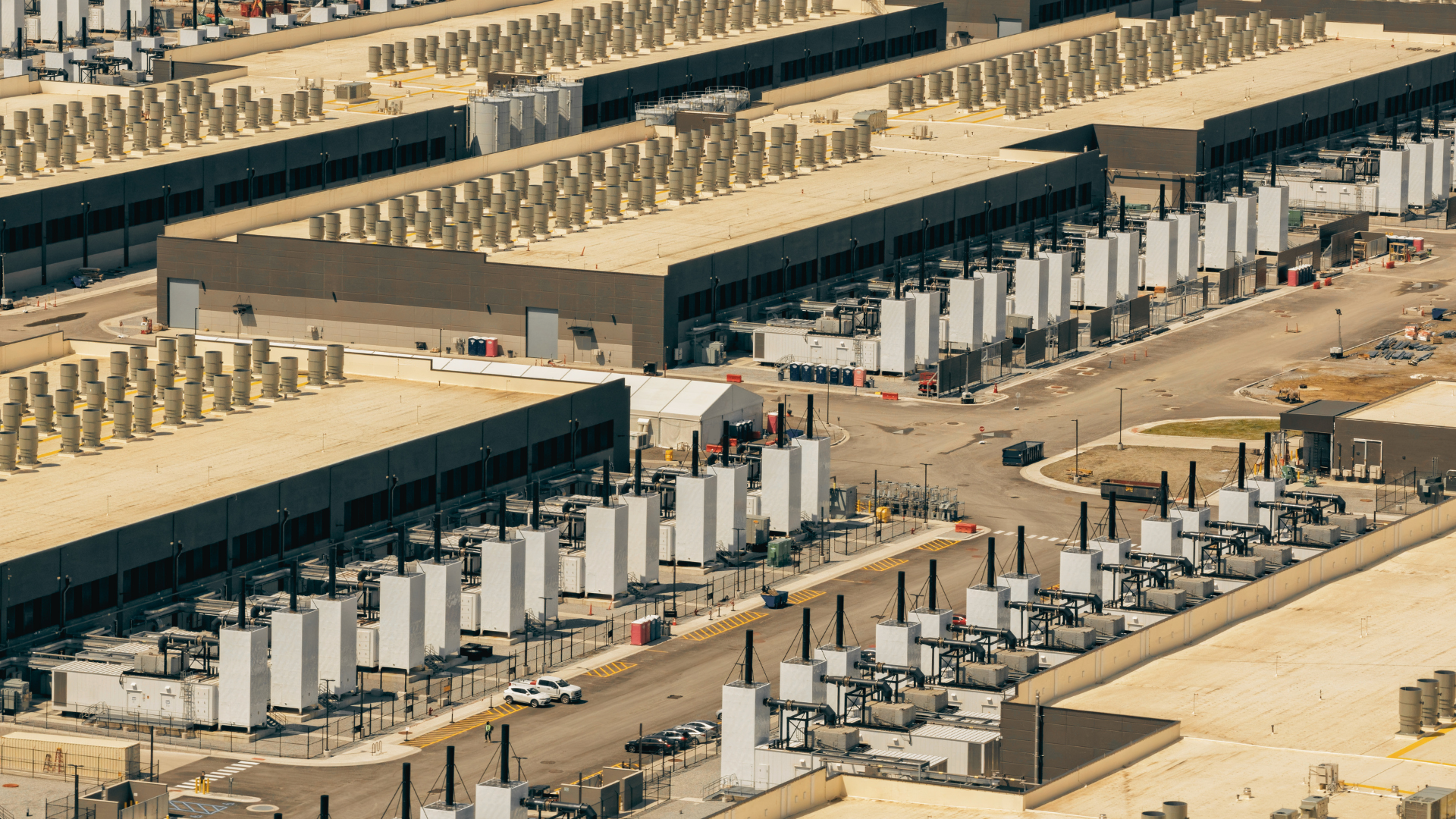
On data centre load, which this newsletter covered on 20 August 2026 in the context of the NSW Data Centre Policy Framework and Transgrid's connection criteria, a further proposal has been lodged. The North Sydney Sun reported that Gateway Capital has an 81 megawatt facility planned for St Leonards, with Lendlease named as a partner in building and running it, and documents lodged with the NSW Government putting the estimate at $1 billion within the Gore Hill cluster [3]. The masthead recorded that the Urbis scoping report describes five storeys and 16,634 square metres of gross floor area on a 1.82 hectare Frederick Street site, with 11 data halls, 44 standby generators, two onsite 33 kilovolt substations and an anticipated power usage effectiveness under 1.3 [3]. Urbis stated that the site was chosen in part for its industrial zoning and "limited nearby residential sensitive receivers" [3].
Procurement, Timber Standards and a Tax Measure That Reaches the Licence
Infrastructure magazine reported that the NSW Government and the industry pressed for reform of procurement, risk allocation and delivery practice at the Australian Constructors Association's Foundations and Frontiers 2026 forum in Sydney, an event the publication put at over 450 senior figures from contracting, government, consulting and the supply chain [7]. NSW Treasurer Daniel Mookhey said "Government is the construction sector's largest client. That gives us power, but it also gives us responsibilities. We must develop projects properly before taking them to market. We must be clearer about scope, more realistic about risk and more consistent in our requirements" [7]. He added that government must "engage industry earlier, make decisions faster and resolve genuine claims without allowing every issue to become an adversarial contest", and that tender assessment should weigh deliverability and whole of life value rather than the lowest headline price [7].
Association President Annabel Crookes said that "genuine partnership starts well before contracts are signed", by which she meant involving contractors early enough to help define the problem and creating conditions in which difficulties are worked through before they harden into disputes [7]. On process, she said that if productivity is to lift, "procurement has to be shorter, smarter and more focused on outcomes", with less time absorbed by drawn out and duplicative competitive processes [7]. Mookhey pointed to method as well, saying the Government wants "greater standardisation, more modern methods of construction and innovation that can be repeated across projects" [7]. Association chief executive Peter Colacino observed that the discussion reinforced that productivity "is no longer simply a construction issue. It's a cost-of-living issue, a housing issue, and an economic issue" [7].
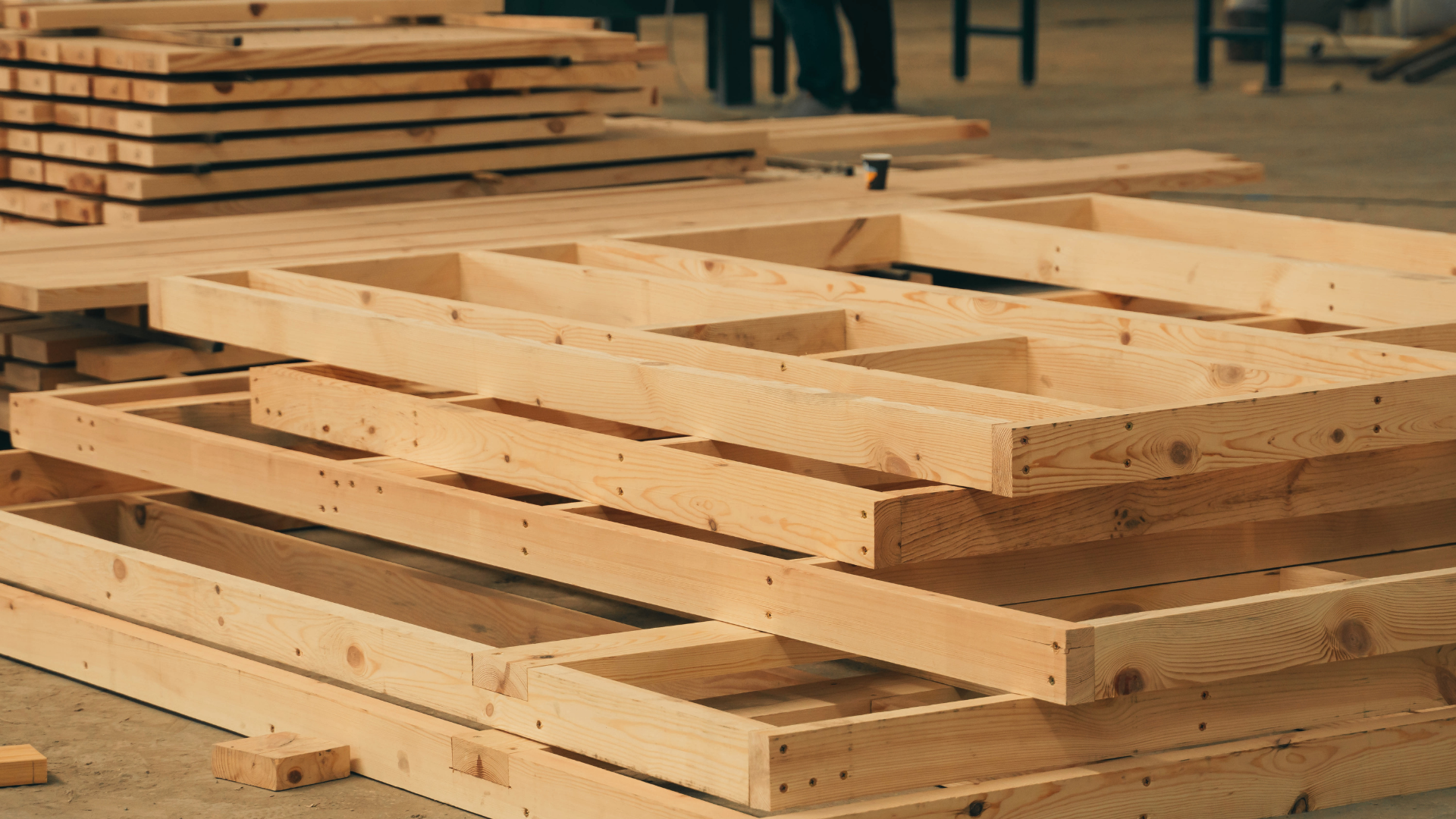
Wood Central reported that a 46 page draft now open for public comment would, for the first time, give Australian structural engineers a single national design method for cross laminated timber elements, taking in floors, walls and stairs [5]. Forest and Wood Products Australia issued the document as FWPA Standard D02 and wrote it to become a CLT section within the 2010 edition of AS 1720.1 [5]. According to the report, the draft uses limit state design in step with the AS/NZS 1170 series and applies a 0.85 capacity factor to CLT design capacities, leaving vibration to govern the floor plate, with a 10 per cent uplift available on the vibration limited span where superimposed dead load is more than double the weight of the panel itself, provided the span stays below 8 metres and no concrete topping is added [5]. Structural adequacy in fire goes either to testing under AS 1530.4 or to calculation on the residual section, and comment closes on 29 September [5].
On business structure, The Good Builder reported that Master Builders Australia lodged a submission with Treasury on 31 July 2026, arguing that for a residential builder the sharpest edge of a proposed 30 per cent trust tax is not the rate but the effect on the licence [2]. The article traces the measure to the 2026 to 2027 Federal Budget on 12 May 2026, under which from 1 July 2028 the trustee of a discretionary trust would face a floor of 30 per cent on the trust's taxable income, with Treasury running an implementation consultation across July 2026 [2]. It records that no bill has been introduced, that no exposure draft has issued, and that the measure is not yet law [2].
On the operational consequences, The Good Builder set out the submission's position that a licence generally cannot move between business structures, so a builder who shifts the business into a newly formed company must obtain a licence in that company's name before it can lawfully contract [2]. The article notes that the statutory warranties in section 18B of the Home Building Act 1989 (NSW) attach to whoever holds the contractor licence, and that where that entity has been wound up the submission asks who a homeowner with a defect claim proceeds against [2]. It records that home warranty schemes in New South Wales, Western Australia, South Australia and both territories answer only as a last resort, on triggers confined to a builder who has died, disappeared or become insolvent, or in some places failed to satisfy a money order of a court or tribunal, and that a voluntary restructure meets none of them [2]. Master Builders chief executive Denita Wawn said that moving a building business between structures "can involve lawyers, accountants, banks, insurers, licences and contracts, all of which cost money" [2].
Final Thoughts
Early engagement was the common thread across most of the week's coverage, with the terms of the work settled ahead of the work itself. The Sydney Plan was reported as a framework set ahead of the rezoning and investment decisions it is intended to guide [1]. At Bankstown and at Sydney Airport, a contractor was reported as appointed under Early Contractor Involvement to finalise design ahead of main works that are not scheduled to start until 2027 [4, 6]. On high speed rail, the same process was reported as running to finalise cost, scope, design and approvals before any investment decision is taken [9]. The procurement reporting from the Australian Constructors Association forum described that sequencing question in general terms, with both the Treasurer and the Association President framing early engagement as the point at which disputes are avoided rather than resolved [7].
The regulatory material reported this week sat at three different distances from operation. The Sydney Plan and its companion instruments were reported as finalised and released [1]. The cross laminated timber draft was reported as open for comment until 29 September, with a route into the building code still to be settled [5]. The trust tax was reported as announced, consulted on and unlegislated, with a start date more than two years away [2]. What connects the second and third is the object each attaches to: a design method attaches to an element, while a licence, a statutory warranty and warranty insurance eligibility all attach to a legal entity, which is the point the Master Builders submission was reported as putting to Treasury [2].
-
NSW Government (12 August 2026). Minns Labor Government finalises 20-year Sydney Plan. https://www.nsw.gov.au/ministerial-releases/twenty-year-sydney-plan-finalised
-
The Good Builder (19 August 2026). The Trust Tax Will Force Builders Into New Entities and New Licences, Leaving a Gap in Home Warranty Cover. https://thegoodbuilder.com.au/the-trust-tax-will-force-builders-into-new-entities-and-new-licences-leaving-a-gap-in-home-warranty-cover
-
North Sydney Sun (20 August 2026). Gateway plans $1bn, 81MW St Leonards data centre. https://northsydneysun.com.au/business-property/gateway-plans-1bn-81mw-st-leonards-data-centre
-
NSW Government (20 August 2026). Planning approval confirmed for new $2 billion Bankstown Hospital as demolition well underway. https://www.nsw.gov.au/ministerial-releases/planning-approval-confirmed-for-new-2-billion-bankstown-hospital-as-demolition-well-underway
-
Wood Central (20 August 2026). Australia Drafts Its First CLT Standard to Slot into AS 1720.1. https://woodcentral.com.au/fwpa-clt-design-methods-d02
-
Architecture AU (21 August 2026). Sydney Airport expansion masterplan approved and underway. https://architectureau.com/articles/sydney-airport-expansion-masterplan-approved-and-underway
-
Infrastructure magazine (21 August 2026). Industry calls for construction productivity reforms. https://infrastructuremagazine.com.au/industry-calls-for-construction-productivity-reforms
-
Architecture AU (24 August 2026). New Bankstown hospital approved. https://architectureau.com/articles/new-bankstown-hospital-approved
-
PS News (24 August 2026). Train, rail and tunnel builders invited to bid for first high-speed rail leg. https://psnews.com.au/train-rail-and-tunnel-builders-invited-to-bid-for-first-high-speed-rail-leg/183868
The Pulse collates the latest news and opinions from third-party sources. Links, snippets or text are generated by an artificial intelligence engine. The Pulse aggregates news reports and does not claim to have copyright to the content. We have not fact-checked that content and cannot vouch for its accuracy or completeness. Nor do we endorse the opinions expressed by the authors or primary publishers. The content is provided as general information only and should not be relied on as a substitute for professional advice. You should contact the source to verify any factual content as well as taking specialist advice that takes your personal objectives and circumstances into account.
.png)
Kreisson
Produced by the team at Kreisson.
Browse Past Issues

Kreisson
We provide the construction industry with simple, easy to understand, solution-based legal advice.