Metro Homes, Defect Cover and Grid Milestones: NSW Approvals and Contracts Move Ahead
This week's reporting attaches housing capacity to transport and surplus public land, and records the first insurance product clearing the new decennial defect cover regime.
The NSW Government placed a draft rezoning for up to 9,400 homes across 168 hectares around the new Woollahra station and Edgecliff on exhibition until 7 October 2026 [12]; awarded an $880 million design and construct contract for the Parramatta Metro station and precinct to a Gamuda-led consortium, lifting the site's dwellings from 111 to 970 [9]; and put forward around 340 homes, 30 per cent of them social housing, on former WestConnex land at Haberfield ahead of a State Significant Development application [6]. On the regulatory side, Building Commission NSW listed a ten-year defect insurance policy as being in a form acceptable to the Secretary, following commencement of the amending reforms on 20 August 2026 [3].
The second thread is the run of consents and connections that precedes construction. Goodman's $1.37 billion, 135 MW data centre at Macquarie Park was approved under the State Significant Development pathway on 2 September 2026 [8]; the 850 MW Waratah Super Battery reached full output for the first time after a rebuilt transformer was energised [10]; and Samsung's 100 MW Mangoplah battery near Wagga Wagga [13] and Hydrostor's 200 MW compressed air facility at Broken Hill [4] each secured grid connection approval. On delivery and capability, Sydney Water awarded Abergeldie the Kemps Creek gravity carrier [5], the Commonwealth and NSW launched a $78 million program to fast track qualifications for up to 6,000 experienced construction workers [7], and prefabAUS put public procurement at the centre of scaling modern methods of construction [11].
Decennial Defect Cover Reaches the Market as the Fair Trading Reforms Commence
Following our recent reporting on the passage of the Fair Trading and Building Legislation Amendment Bill 2026, Building Commission NSW now records that the amending legislation received assent on 14 August 2026 and that its reforms commenced on 20 August 2026 [3]. A commencement proclamation signed by the Governor on 19 August 2026 and published on 20 August 2026 appoints that day for Schedule 17(1) and (3) to (5) of the Fair Trading and Building Legislation Amendment Act 2026, the items that carry the insurance changes [2]. The Commission describes the changes as clarifying the scope of decennial liability insurance, which it defines as ten-year cover for residential strata buildings over three storeys, taken out by the developer before an occupation certificate issues, and attaching to the building rather than the developer [3]. The Commission summarises the clarified scope as covering defects that breach the Building Code of Australia, an Australian Standard or the approved plans and that "cause or are likely to cause damage or risk of death or serious injury" [3].
The Commission's page also carries the first product to clear the regime. It lists the Resilience Insurance Latent Defects Insurance Policy as reviewed and determined to be in a form acceptable to the Secretary [3]. For developers of class 2 buildings, the Commission sets out that a policy in the acceptable form may be held instead of the bond required under the Strata Building Bond and Inspections Scheme, that only one of the two is needed for an occupation certificate, and that a notice of intention to take out the cover, with a certificate of currency, must be lodged through the NSW Planning Portal before construction starts [3]. The planned increase to the bond, currently 2 per cent of the project, has been deferred to 1 July 2028 [3].
The design traces to the Decennial Liability Insurance Ministerial Advisory Panel, whose August 2022 advice to the NSW Government proposed a preferred model in which the strata building bond scheme would be repealed and decennial cover made mandatory after a transition period [1]. The Panel found that without a mandatory obligation at the end of that transition it was unclear a mature insurance market would develop, and that in a mature market the cost of cover would not unduly burden project costs or housing supply [1]. It also recommended increasing the bond and holding it longer once eligible products entered the market, so that developers compared the two options early [1].
Woollahra Goes on Exhibition as Parramatta Metro Lifts Its Housing Yield
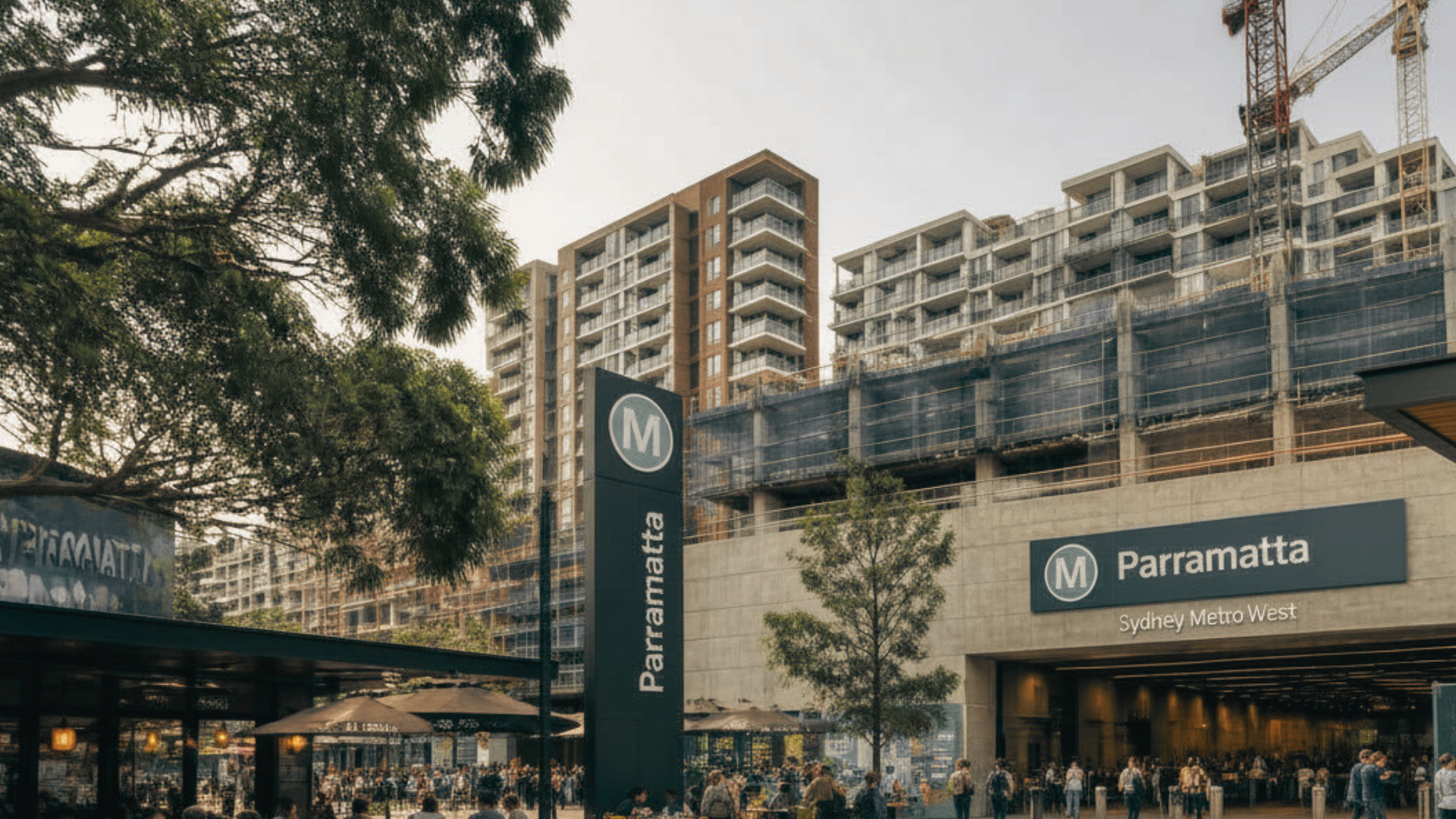
The NSW Government has placed a draft rezoning for Woollahra and Edgecliff on exhibition from 8 September to 5pm on 7 October 2026, covering 168 hectares in Sydney's east and as many as 9,400 homes around Edgecliff station and the new Woollahra station on the T4 line [12]. The release describes buildings rising to 34 storeys near Edgecliff and 32 near Woollahra, up to 40 per cent of new dwellings within 200 metres of a station and a 3 per cent affordable housing contribution rising to as much as 15 per cent on certain sites in perpetuity [12]. It also confirms a value capture mechanism: any development within 800 metres of the Woollahra station is to attract a Transport Project Component contribution, set at $15,000 for each dwelling or $200 for each square metre of new commercial floor area, toward the station, which the Government expects to open in 2029 [12]. Premier Chris Minns said the proposal asked the area to make a fair contribution to Sydney's growth, and Transport Minister John Graham said station design was under way with construction expected to start next year [12].
In Parramatta, the Government announced that the $880 million design and construct contract for the Metro West station, its precinct and the development above and beside it has gone to a Gamuda Engineering-led consortium with MTR Corporation [9]. Following our recent reporting on Metro West tunnelling and track laying, the release records that the station box, 192 metres long, 25 metre-wide, and 28 metres deep, is excavated and structurally complete, with station construction to start in mid-2027 for the line's 2032 opening [9]. The revised scheme lifts dwellings from the 111 in the March 2025 concept plan to 970 across four buildings: a 29-storey commercial tower, a 24-storey student building of 500 units, an eight-storey hotel and a 43-storey build-to-rent tower holding the 470 apartments, set around a park on Parramatta's Civic Link [9]. Final designs remain subject to planning approval and exhibition, and procurement for the Sydney Olympic Park and Pyrmont station developments is under way with awards expected by the end of 2026 [9]. Planning Minister Paul Scully said, "Connecting major transport investments with more homes, close to jobs, services and amenities is sensible city planning." [9]
In the Inner West, the Government revealed plans for around 340 homes across four buildings of three to seven storeys on former WestConnex land at Alt Street, Bland Street and Parramatta Road in Haberfield and Ashfield, with 30 per cent set aside for social housing [6]. The release describes the sites as identified through the statewide audit of surplus public land and the latest to proceed under the Government's Building Homes for NSW program, valued in the release at $6.6 billion, and states that Homes NSW is seeking early community feedback before lodging a State Significant Development application [6]. Housing Minister Rose Jackson said, "we need to make the most of every suitable site we have, particularly in well-connected locations" [6].
Macquarie Park Data Centre Approved as Storage Projects Clear the Grid
Following our recent reporting on the terms data centres face to connect to the NSW grid, Urban Digest reports that Goodman Property Services' $1.37 billion Project Apollo data centre at 4-10 Talavera Road in Macquarie Park has received approval under the State Significant Development pathway, with the determination dated 2 September 2026 [8]. The approved scheme is a five-storey, 45-metre facility with 28,878 square metres of gross floor area across eight data halls and 135 MW of data capacity [8]. Urban Digest records that the application, designed by HDR, was determined after 541 days and a single public objection, and is expected to generate 400 construction jobs and 60 operational roles [8].
On the Central Coast, Renew Economy reports that the 850 MW Waratah Super Battery at the former Munmorah power station site has reached full output for the first time, after a 170-tonne transformer rebuilt by Wilsons Transformers was energised to replace a unit damaged last October [10]. The publication notes that the battery, owned by Akaysha Energy, holds the 700 MW System Integrity Protection Scheme contract, and that it had operated under a 700 MW limit while the third transformer was rebuilt [10]. Renew Economy records that the facility injected 850 MW into the grid on Wednesday, with final testing to follow before it can deliver the SIPS contract in full [10].
Two storage projects also cleared connection gateways. pv magazine reports that Samsung C&T Renewable Energy Australia has received a 5.3.4A letter confirming that its 100 MW, 400 MWh Mangoplah battery, some 30 kilometres south of Wagga Wagga, satisfies the technical conditions for connection to the National Electricity Market via the 132 kV line crossing the site, with construction expected to begin in 2027 subject to remaining approvals [13]. Energy Source and Distribution reports that Hydrostor has secured grid connection approval from AEMO and Transgrid for its 200 MW, 1,600 MWh Silver City Energy Storage Centre beside the Potosi Mine at Broken Hill, confirming compliance with Generator Performance Standards for a compressed air facility offering up to eight hours of storage, with 50 MW and 250 MWh reserved as backup supply for the Far West during outages [4]. Hydrostor country lead Martin Becker said, "Grid connection approval is another significant step for Silver City" [4].
Sydney Water Awards the Kemps Creek Carrier as Trade Qualifications and Prefab Procurement Move Up the Agenda
Trenchless Australasia reports that Abergeldie Complex Infrastructure has been awarded the Kemps Creek Gravity Carrier Extension (North) Pipeline by Sydney Water, a wastewater project serving growth in the Upper South Creek catchment, including Western Sydney International Airport and the suburbs around it [5]. The scope covers trenchless construction of roughly 2.9 kilometres of gravity carrier with the design, supply and installation of GRP maintenance holes and ventilation shafts [5]. Chief executive Mark Bruzzone said the company would self-perform a significant portion of the works with its specialist tunnelling plant, and the publication notes that Abergeldie is also part of the utility's West Region Delivery Team [5].
On workforce, the Commonwealth and NSW governments announced the $78 million Advanced Entry Trades Training program, under which recognition of prior learning and gap training will allow up to 6,000 experienced but unqualified workers in residential and civil construction to complete a trade qualification in months rather than years [7]. The release confirms that NSW is among the first states to sign on, that the program is modelled on the NSW Trade Pathways for Experienced Workers scheme under which more than 1,900 students have qualified, and that it will be open to workers who have three or more years of experience, with enrolments from late 2026 and the program running to 30 June 2028 [7]. NSW Skills Minister Steve Whan said the state's experienced-worker pathway had shown the approach worked and that NSW was partnering with the Commonwealth to extend it [7].
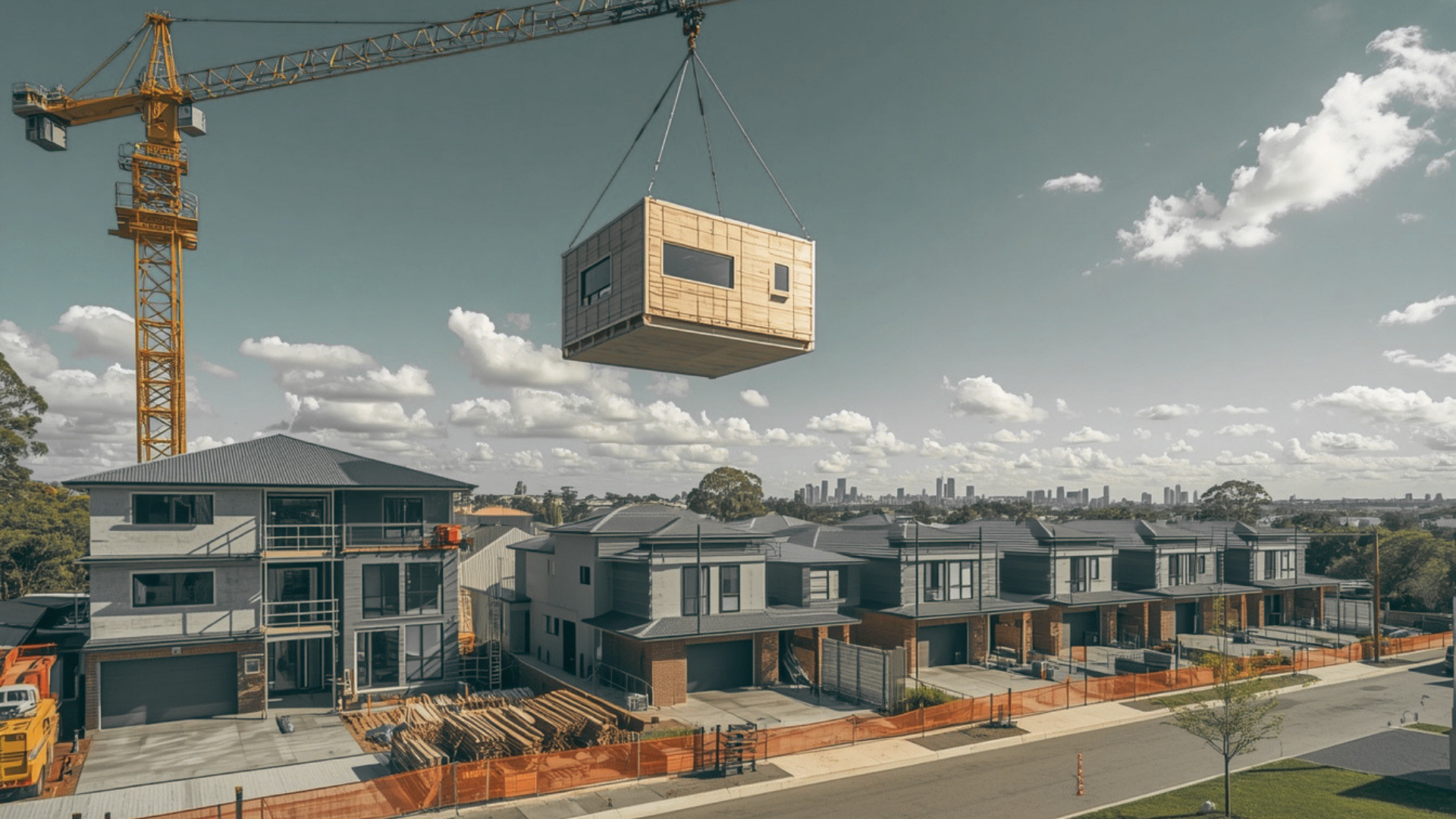
Following our recent reporting on modular and prefabricated housing, Built Offsite reports that prefabAUS used the opening of the second day of Offsite '26, held in Melbourne on 2 and 3 September 2026, to set priorities for year four of a ten-year roadmap, with strategic public procurement and domestic manufacturing at the centre [11]. Industry strategist Lance Worrall named codes and certification, finance, procurement, design for manufacture and assembly, and workforce as the priorities emerging from industry engagement, observing that factory production needs larger upfront payments than site-based progress claims [11]. He pointed to NSW's pattern book, planning reforms and planned MMC innovation facility as examples of government organising demand, and said, "Government will return to being a builder" [11]. The publication also records that prefabAUS has released a standard form contract for prefabricated homes, aimed at consumer protection and factory-stage payments [11].
Final Thoughts
Read together, the week's government releases pair each housing number with an infrastructure trigger. The Woollahra proposal is priced against a new station through a per-dwelling contribution [12], the Parramatta scheme draws its expanded yield from the contract that builds the station beneath it [9], and the Haberfield homes come off land no longer needed by the WestConnex project [6]. The reporting on Mangoplah [13], Silver City [4] and Macquarie Park [8] describes the same sequence on the energy side, with connection letters, performance standards and planning consent secured before any of those projects reaches site.
The insurance and capability stories sit at the other end of a project. Building Commission NSW's listing of an acceptable decennial policy [3], commenced by proclamation on 20 August 2026 [2], moves a reform first described in the 2022 advisory panel report [1] from design into a product a developer can now buy, with the bond increase the panel proposed as the incentive deferred to 2028 [3]. The Advanced Entry Trades Training program [7] and the prefabAUS agenda [11] both concern who does the work and how it is procured, and the reporting on each framed qualified labour and factory capacity as constraints to be organised by government rather than left to individual projects.
-
Decennial Liability Insurance Ministerial Advisory Panel (NSW Department of Customer Service) (August 2022). Discussion Paper: Decennial Liability Insurance Ministerial Advisory Panel Advice to NSW Government. https://www.nsw.gov.au/departments-and-agencies/building-commission/industry-changes/ten-year-defect-insurance-for-apartment-buildings
-
NSW Legislation (Governor of New South Wales) (20 August 2026). Commencement Proclamation under the Fair Trading and Building Legislation Amendment Act 2026 No 28 (2026 No 424). https://legislation.nsw.gov.au/epub?bulletin=20260823
-
Building Commission NSW (28 August 2026). Ten-year defect insurance for apartment buildings. https://www.nsw.gov.au/departments-and-agencies/building-commission/industry-changes/ten-year-defect-insurance-for-apartment-buildings
-
Energy Source and Distribution (2 September 2026). Silver City Energy Storage Centre secures grid tick. https://esdnews.com.au/silver-city-energy-storage-centre-secures-grid-tick
-
Trenchless Australasia (4 September 2026). Abergeldie trenchless track record lands it microtunnelling contract from Sydney Water. https://trenchless-australasia.com/abergeldie-trenchless-track-record-lands-it-microtunnelling-contract-from-sydney-water
-
NSW Government (6 September 2026). Plans for 300+ homes at Haberfield dive site revealed. https://www.nsw.gov.au/ministerial-releases/plans-new-homes-haberfield
-
NSW Government (6 September 2026). Thousands of construction workers to get free qualifications under new national program. https://www.nsw.gov.au/ministerial-releases/free-qualifications-construction-workers
-
Urban Digest (6 September 2026). Goodman's $1.37bn Data Centre Approved for Macquarie Park. https://urbandigest.com.au/ssd-74069708-goodmans-1-37bn-data-centre-approved-for-macquarie-park
-
NSW Government (7 September 2026). Big boost in homes for Parramatta Metro station development. https://www.nsw.gov.au/ministerial-releases/big-boost-homes-for-parramatta-metro-station-development
-
Renew Economy (7 September 2026). Australia's most powerful battery finally reaches full capacity as replacement transformer energised. https://reneweconomy.com.au/australias-most-powerful-battery-finally-poised-to-reach-full-capacity-as-replacement-transformer-energised
-
Built Offsite (8 September 2026). prefabAUS puts procurement and Australian manufacturing at centre of MMC scale-up. https://builtoffsite.com.au/news/prefabaus-puts-procurement-and-australian-manufacturing-at-centre-of-mmc-scale-up
-
NSW Government (8 September 2026). First look: Woollahra long-term housing transformation. https://www.nsw.gov.au/ministerial-releases/first-look-woollahra-long-term-housing-transformation
-
pv magazine Australia (8 September 2026). Samsung secures key grid milestone for 400 MWh battery project. https://www.pv-magazine-australia.com/2026/09/08/samsung-secures-key-grid-milestone-for-400-mwh-battery-project/
The Pulse collates the latest news and opinions from third-party sources. Links, snippets or text are generated by an artificial intelligence engine. The Pulse aggregates news reports and does not claim to have copyright to the content. We have not fact-checked that content and cannot vouch for its accuracy or completeness. Nor do we endorse the opinions expressed by the authors or primary publishers. The content is provided as general information only and should not be relied on as a substitute for professional advice. You should contact the source to verify any factual content as well as taking specialist advice that takes your personal objectives and circumstances into account.
.png)
Kreisson
Produced by the team at Kreisson.
Browse Past Issues


Kreisson
We provide the construction industry with simple, easy to understand, solution-based legal advice.